Living in Bel Air, Los Angeles: 2026 Guide
The comfort of a second home. The convenience of a hotel. The reliability of Rove.
Most people searching Bel Air already know it's expensive and private. What's less obvious is how much the experience changes depending on whether you're in lower, mid, or upper Bel Air, and what renting versus buying there actually looks like in 2026. This breaks it down tier by tier.
TLDR:
- Bel Air covers 6.37 square miles in the Santa Monica Mountains foothills, with 1,207 residents per square mile and 85.5% owner-occupancy.
- The median sale price is $3.5 million as of mid-2026, up 5.9% year-over-year; upper-tier compounds push well above $10 million.
- Only 14.5% of housing is renter-occupied; furnished rentals start around $8,000 to $12,000 per month with 30-day minimums.
- Violent crime is rare; the gated roads and private network reduce opportunistic access compared to standard Los Angeles neighborhoods.
- Rove offers curated furnished rentals across Los Angeles, including Westside properties, with move-in-ready homes and a four-step guest vetting process.
A Brief History of Bel Air
Bel Air was founded in 1922 by Alphonzo Bell, a California oil magnate who purchased the hillside land and predicted the development would be "the crowning achievement of suburban development." Bell saw the foothills of the Santa Monica Mountains as the natural home for Los Angeles's wealthy class, drawn to high terrain with sweeping city views as automobile ownership made hillside living practical.
North of Sunset Boulevard, Bell carved out a planned community with private gates, winding roads, and strict residential standards. The gate system remains one of Bel Air's most recognizable features, marking the boundary between public Los Angeles and a guarded enclave. That separation was intentional from the start and has never loosened.
Over the following decades, Bel Air attracted entertainers, industrialists, and well-known families who valued privacy above almost everything else, growing slowly and deliberately enough that its residential character feels intact a century later.
Bel Air Neighborhood Map and Geography
Bel Air covers roughly 6.37 square miles in the foothills of the Santa Monica Mountains, on Los Angeles's Westside. Beverly Hills sits to the south, Brentwood to the west, and Westwood to the southwest. Sunset Boulevard forms the southern boundary and main entry corridor.
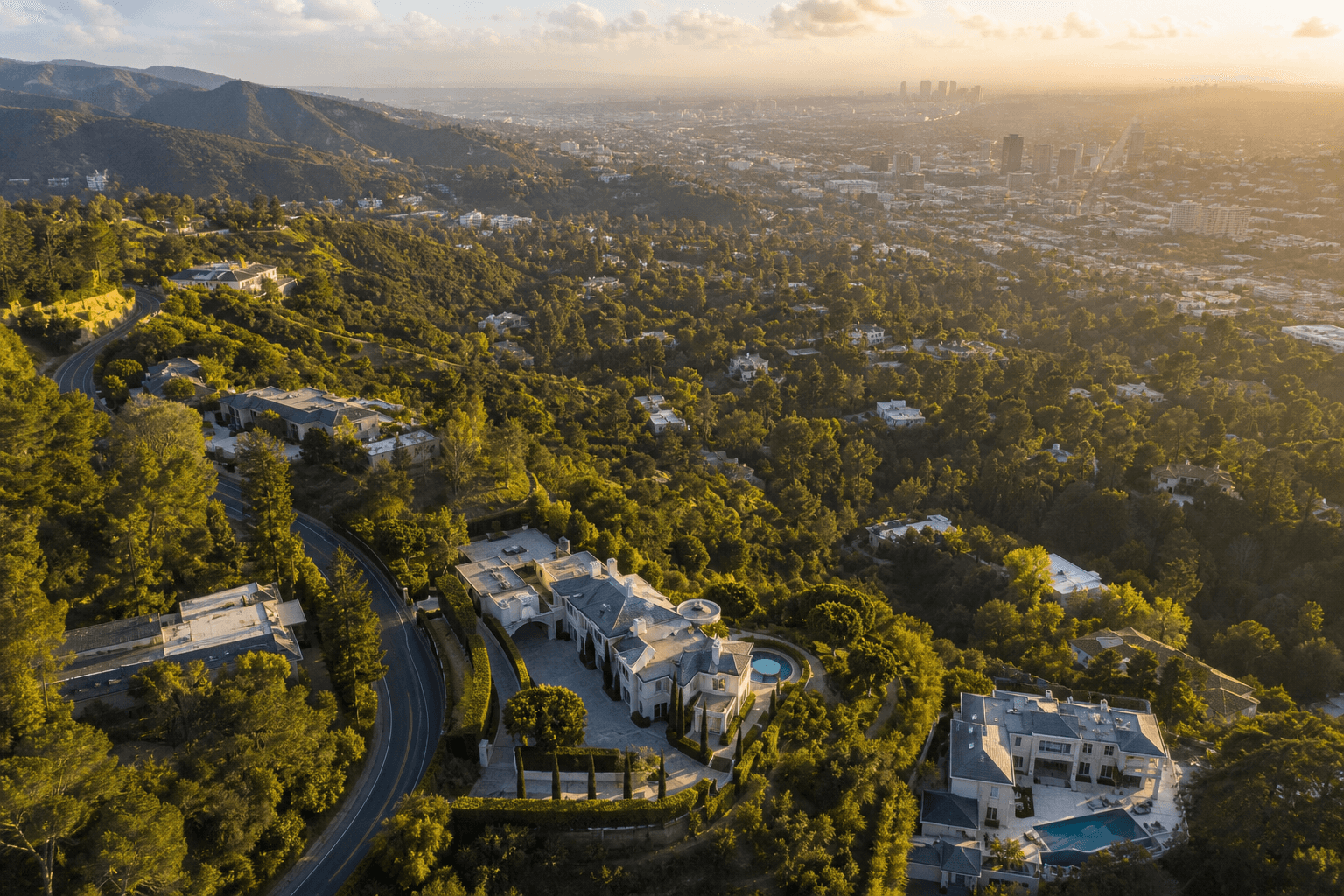
Two gates mark primary access: the east gate at Sunset and Bellagio Drive, and the west gate near Sepulveda. Both appear on nearly every map reference for the area.
Lower, Mid, and Upper Bel Air
The neighborhood divides informally into three elevation tiers, each with a distinct character.
- Lower Bel Air sits closest to Sunset with relatively accessible price points by local standards.
- Mid Bel Air climbs the hillside along roads like Bellagio and St. Cloud.
- Upper Bel Air offers the most seclusion, the largest estates, and views stretching to the Pacific on clear days.
Bel Air Road: The Most Famous Street in the Neighborhood
Bel Air Road winds through the upper reaches of the neighborhood, connecting estates that rarely appear on the open market. The name carries immediate recognition in Los Angeles real estate circles, partly because of the scale of what sits behind the hedges, and partly because of one property that pulled the street into mainstream conversation.
1200 Bel Air Road, listed at $99.95 million. The 12-bedroom estate, built in 2021 on two acres above the city, was featured on Netflix's "Selling Sunset," making the street name a search term in its own right. Beyond that listing, the road is representative of what upper Bel Air offers generally: private driveways, gated entries, and properties sized for compound living instead of standard residential use.
What It's Like to Live in Bel Air
Bel Air's winding roads discourage through traffic, lot sizes keep neighbors at a distance, and gate systems mean most streets see almost no foot traffic from outsiders.
With roughly 1,207 residents per square mile, Bel Air ranks among the least dense neighborhoods in Los Angeles County, translating to genuine quiet: no crowded sidewalks, minimal street noise, and residential calm that persists even on weekday mornings. Owner-occupancy sits at 85.5%, keeping turnover low and the community stable.
The trade-off is car dependency for nearly everything. Grocery runs, coffee, school pickups, and restaurant dinners all require driving down to Sunset or into Westwood and Brentwood. For anyone expecting walkable urban convenience, this neighborhood will feel remote.
Bel Air Home Prices and the Real Estate Market
Zillow puts the average Bel Air home value at $4,163,260, up 5.9% year-over-year. Redfin data shows a median sale price of $3.5 million over recent months, with homes averaging 63 days on market versus 78 the year prior.
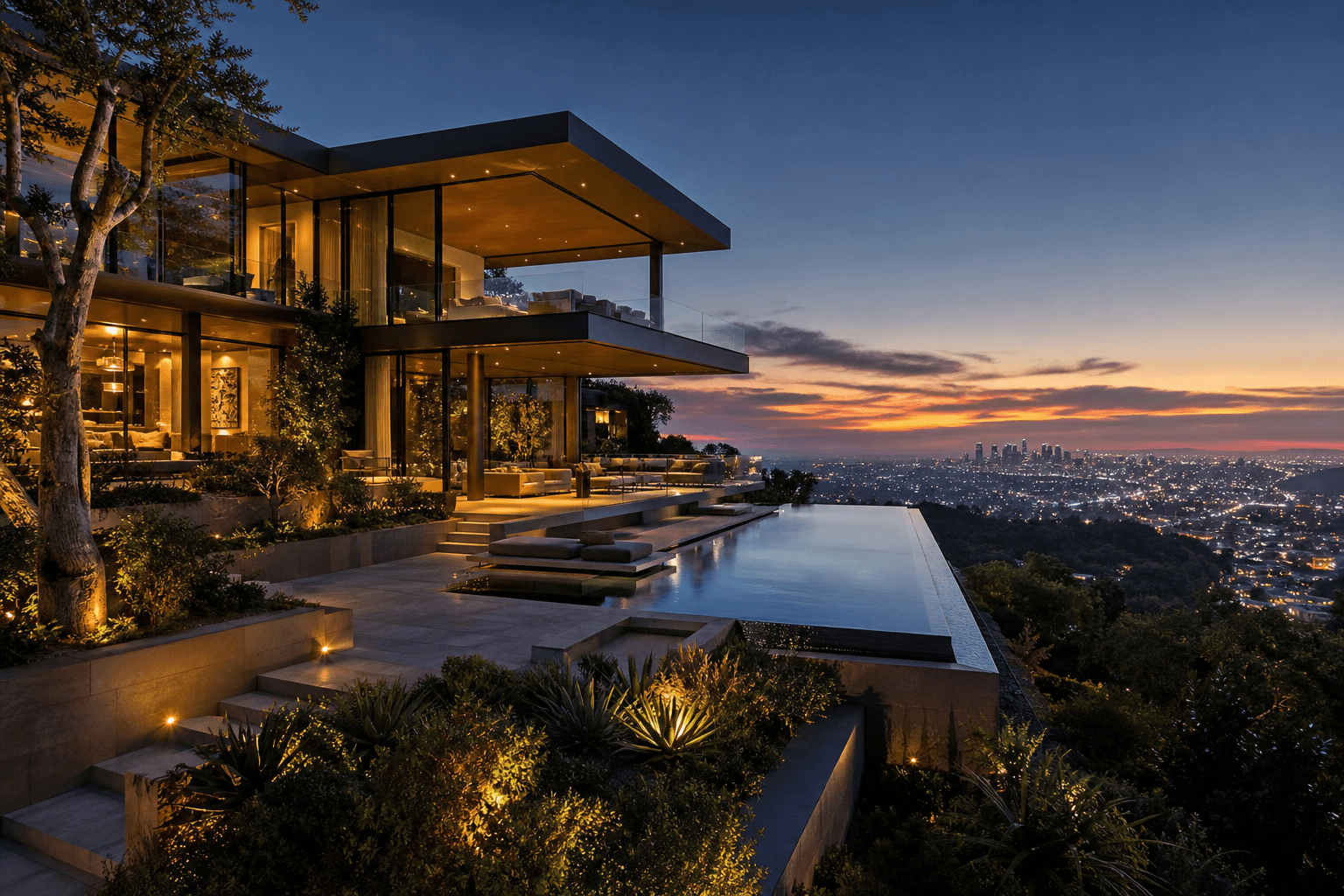
Pricing varies sharply by elevation. Lower Bel Air entries start in the low millions. Mid-tier hillside properties on streets like Bellagio and St. Cloud typically land in the $4 to $8 million range. Upper Bel Air compounds, where lots routinely exceed an acre and views reach the ocean, push well above $10 million. Inventory skews heavily toward single-family estates: mid-century properties on oversized lots, contemporary builds with glass walls and canyon outlooks, and older compounds renovated over decades, a mix that shapes how buyers weigh a second home vs investment property in this market. Condos are rare, and an 85.5% owner-occupancy rate confirms this is a market built for long-term holders.
Renting in Bel Air: Apartments and Furnished Options
Only 14.5% of Bel Air's housing stock is renter-occupied, which makes the rental pool thin and competitive by design. Apartment buildings are nearly nonexistent. What the market offers is detached homes, guesthouses on larger estate parcels, and the occasional converted carriage house.
Monthly furnished mid-term rentals circulate mostly through private brokers and referral networks. Price floors start around $8,000 to $12,000 per month for smaller properties, with mid-tier hillside houses running $15,000 to $25,000 and upper-tier estates above that. Most landlords prefer longer commitments from vetted tenants, with 30-day minimums as the floor.
Safety and Crime in Bel Air
Bel Air falls under the LAPD's West Los Angeles Division. The gated entrances and private road network that define the neighborhood's geography also function as passive crime deterrents: without through-traffic or foot access, opportunistic offenders have fewer entry points than in a standard LA neighborhood.
Violent crime is rare. The more common concern is residential burglary, consistent with high-wealth, low-density enclaves across the city where large homes and long driveways can reduce street visibility. Property crime is the realistic risk, not personal safety.
No neighborhood in Los Angeles is crime-free, but the combination of private roads, low residential density, and gate infrastructure keeps the day-to-day experience quieter than most parts of the city.
Schools Near Bel Air
Bel Air sits within the Los Angeles Unified School District, with public school assignments falling under the 90077 zip code. The Brentwood Science Magnet School is the most notable public option, drawing families from across the Westside.
Most Bel Air families default to private enrollment, given the concentration of elite institutions nearby. Harvard-Westlake School on Coldwater Canyon ranks among the top college-preparatory schools in California, a detail that matters for executives weighing corporate housing options near good schools. Brentwood School and Mirman School are also within a short drive.
Dining, Shopping, and Amenities
Bel Air has almost no commercial development by design. The neighborhood's founding ethos put residential privacy above convenience, which means residents drive out for nearly everything.
The one on-site exception is the Hotel Bel-Air restaurant, a Dorchester Collection property with a bougainvillea-framed terrace that draws diners from across the Westside. It functions as a neighborhood landmark for special occasions, not a daily resource.
For everyday needs, residents head to Westwood Village about four miles away for groceries, pharmacies, and casual dining. Brentwood Country Mart is a popular weekend stop, and Beverly Hills' dining and retail along Little Santa Monica and Rodeo Drive is a straight shot south on Wilshire. Most daily meal choices pull residents toward Brentwood or West Hollywood.
Parks, Hiking, and Outdoor Access
Bel Air's hillside position puts several worthwhile outdoor options within a short distance.
The Getty View Trail, reached from Sepulveda Pass, delivers sweeping views over the Westside with a real elevation gain. Franklin Canyon Ranch, part of the Santa Monica Mountains National Recreation Area, adds canyon trails and a pond loop that feel removed from the city despite sitting minutes from Sunset Boulevard.
The Hannah Carter Japanese Garden, on the UCLA campus at the neighborhood's southern edge, offers a quieter option than the hilltop estates and penthouse living found elsewhere in the city: a formal garden donated to the university in 1964, with stone lanterns, a tea house, and koi ponds. Access has historically been limited to scheduled visits, so confirming current hours before going is worth doing.
Getting Around: Transportation and Commuting
Car ownership in Bel Air is non-negotiable. Winding private roads, gated entries, and near-zero sidewalk infrastructure make walking or cycling impractical, and public transit inside the neighborhood is essentially nonexistent.
Most commutes funnel onto Sunset Boulevard toward either the 405 or Beverly Hills and the 10 Freeway. The 405 runs through the Sepulveda Pass directly west, convenient in theory but congested during rush hour. Trips to Century City, Westwood, or Santa Monica are manageable off-peak; the same routes can double in travel time during peaks, a factor worth weighing when mid-term rentals simplify relocation for a new job in the area.
The privacy and lot sizes that define Bel Air are inseparable from the car dependency that comes with them.
Bel Air in Popular Culture
Few Los Angeles neighborhoods have a pop culture footprint that rivals Bel Air's. The Fresh Prince of Bel-Air ran for six seasons beginning in 1990, planting the zip code in the cultural imagination of an entire generation. The 2022 Peacock reboot, simply titled Bel-Air, renewed that association for a younger audience. Neither show filmed inside the actual neighborhood, but both used its name as shorthand for a specific version of American wealth.
Real estate transactions have kept it in headlines independently. 1200 Bel Air Road's appearance on Netflix's Selling Sunset turned a single street name into a recurring search term, while The One, a 105,000-square-foot mega-mansion built nearby, drew international media coverage during its lengthy bankruptcy proceedings. The resident roster typically includes working entertainment figures, studio executives, and tech founders who value privacy enough to pay for it, often maintaining a second residence here following a guide to creating the perfect pied-à-terre.
Who Lives in Bel Air: Demographics and Resident Profile
Bel Air's roughly 8,000 residents are older, wealthier, and more likely to be married than in almost any other Los Angeles neighborhood. As of the 2000 census and a 2008 city estimate, the median age sat around 46, with residents aged 50 and older representing one of the county's highest concentrations. Married-couple households dominated at roughly 66% of men and 65.7% of women, well above city and county averages, while single-parent households accounted for just 4.1% of families.
As of a 2008 estimate, household income ranked highest of any neighborhood in Los Angeles County. The resident profile reflects that: entertainment executives, finance professionals, long-tenured business owners, and current and former celebrities make up the core.
Bel Air vs. Neighboring Luxury Enclaves
The table below shows how Bel Air stacks up against the closest luxury alternatives on the Westside.
| Neighborhood | Price Range | Lifestyle | Walkability | Commercial Access |
|---|---|---|---|---|
| Bel Air | $3.5M to $20M+ | Maximum privacy, gated | Very low | Drive to everything |
| Beverly Hills | $3M to $15M+ | Prestige with amenities | Moderate | Rodeo Drive, shops nearby |
| Brentwood | $2M to $10M | Relaxed, family-focused | Moderate | Country Mart, cafes |
| Holmby Hills | $5M to $30M+ | Ultra-private, estate scale | Very low | Drive to everything |
| Pacific Palisades | $3M to $12M | Coastal, community feel | Moderate | Palisades Village |
Bel Air and Holmby Hills both value seclusion, with gated roads and estate-sized lots that keep neighbors invisible. The distinction is scale: Holmby Hills properties tend to run larger with higher price floors, while Bel Air offers more variety across elevation tiers. Beverly Hills trades some privacy for walkability, retail, and access to Beverly Hills Unified schools, which matters for families. Brentwood suits buyers who want Westside positioning without the gates. Pacific Palisades stands apart with coastal proximity and a small-town character around Palisades Village, though the 2025 wildfires caused extensive damage there and reconstruction timelines remain active as of late 2026, pushing some displaced residents toward furnished corporate housing while they wait. If privacy is the priority, Bel Air wins by design. If walkability or school access matters more, Beverly Hills or Brentwood deserve serious consideration.
Renting a Luxury Home in Bel Air for an Extended Stay
Luxury vacation rentals in Bel Air serve a narrow, purposeful segment: executives on Los Angeles assignments, families in temporary housing during estate renovations, and professionals relocating to the Westside who want to live inside a neighborhood before deciding whether to buy.
A 30-day stay typically starts around $12,000 per month for a smaller property and runs $25,000 to $50,000 or more for a hillside compound with full staff facilities. For a family mid-renovation or a senior executive on a 60-day project, luxury temporary housing with a chef's kitchen eliminates restaurant dependency, multiple bedrooms accommodate working and sleeping separately, and a private gate delivers quiet that no hotel lobby can match.
Staying in Bel Air with Rove
We offer curated furnished rentals across Los Angeles, including properties on the Westside within reach of Bel Air. Every listing is move-in ready from day one: dedicated workspaces, high-speed Wi-Fi, and chef-grade kitchens are baseline requirements, not upgrades. All guests clear a four-step vetting process before booking, and every stay includes pre- and post-stay inspections. For a 30-day or longer stay in the Los Angeles area, browse our Los Angeles properties directly at Rove.
Final Thoughts on Bel Air as a Place to Live
The case for Bel Air is straightforward: if privacy, lot size, and residential quiet matter more than walkability or urban convenience, this neighborhood delivers on all three better than almost anywhere else on the Westside. The car dependency is real, and so is the price floor, but the community has stayed remarkably stable for a century because the people who move here want exactly what it offers. If you want to experience the neighborhood for 30 days or more before making a longer commitment, Rove has furnished options across the Westside worth browsing.
FAQ
What is Bel Air in Los Angeles actually like to live in day-to-day?
Bel Air is a low-density, car-dependent hillside enclave with roughly 1,207 residents per square mile, gated entrances, and winding private roads that produce genuine quiet, not simulated privacy. You drive to everything: groceries, coffee, school pickups, typically heading toward Westwood or Brentwood, since the neighborhood itself has almost no commercial development by design.
Is Bel Air safe compared to other Los Angeles neighborhoods?
Violent crime is rare in Bel Air. The realistic risk is residential burglary, which is consistent with other high-wealth, low-density enclaves across Los Angeles where large lots and long driveways reduce street visibility. The gated entries and private road network limit foot access from outsiders, which passively reduces opportunistic crime compared to standard LA neighborhoods.
What does it cost to rent in Bel Air for 30 days or more, and what kind of properties are actually available?
Furnished rentals start around $8,000 to $12,000 per month for smaller properties, with mid-tier hillside houses running $15,000 to $25,000 and upper-tier compounds above that. The rental pool is thin: only 14.5% of housing stock is renter-occupied, and it skews heavily toward detached homes, guesthouses on larger estate parcels, and the occasional converted carriage house, with almost no apartment buildings.
Bel Air vs. Beverly Hills for a luxury extended stay in Los Angeles: which makes more sense?
Bel Air delivers maximum privacy, lower residential density, and estate-sized lots, but requires driving for everything and has no walkable retail. Beverly Hills trades some seclusion for moderate walkability, proximity to Rodeo Drive and Little Santa Monica dining, and access to Beverly Hills Unified schools, which is a meaningful distinction for families with children on a 30-plus-night stay. If daily quiet and compound-scale space are the priority, Bel Air wins; if school access or the ability to walk to dinner matters, Beverly Hills deserves serious consideration.
What happened with 1200 Bel Air Road and why does it come up so often in searches?
1200 Bel Air Road is a 12-bedroom estate listed at $99.95 million that was featured on Netflix's "Selling Sunset," which turned the street name into a recurring search term independent of the broader neighborhood. The property sits on two acres in upper Bel Air and was built in 2021. Its media profile made Bel Air Road, already one of the most recognized streets in Los Angeles real estate circles, familiar to a much wider audience.