Best NYC Neighborhoods for Families Seeking Luxury Monthly Rentals (May 2026)

The comfort of a second home. The convenience of a hotel. The reliability of Rove.
Choosing the right NYC neighborhood for your family comes down to four measurable factors: school zone boundaries, commute time, outdoor space access, and rent per square foot. Park Slope sits adjacent to Prospect Park's 585 acres and feeds into top-rated public schools. Battery Park City offers waterfront esplanades and strong school ratings but runs higher per square foot than Brooklyn alternatives. Manhattan neighborhoods like the Upper West Side and Upper East Side command a higher price due to Central Park proximity over Brooklyn options at comparable price points. This guide covers eight neighborhoods where families on 30-plus night monthly rentals find the right balance of space, safety, schools, and transit access.
Key Takeaways:
- School access drives neighborhood choice: a single block can determine public school eligibility or force you into private schools costing tens of thousands of dollars per year.
- Park Slope two-bedrooms run $4,500 to $6,500 monthly; Brooklyn tends to offer more square footage per dollar than Manhattan options at similar price points.
- Monthly rentals of 30+ nights qualify families for local school enrollment and comply with NYC's Local Law 18.
- Brooklyn neighborhoods post lower crime rates and higher walkability than Manhattan equivalents, with Prospect Park's 585 acres adjacent to Park Slope.
- Rove Travel lists over 200 vetted properties across Park Slope, Battery Park City, Brooklyn Heights, and Tribeca, all fully furnished for 30+ night stays.
How to Choose the Right NYC Neighborhood for Your Family
Four factors tend to separate neighborhoods that work well for families from those that don't, regardless of budget.
School Access
NYC's public school zones are hyperlocal, meaning a single block can determine whether your child qualifies for a well-rated school or requires a private alternative that can run well into five figures annually. Families securing monthly rentals of 30 nights or more often qualify to enroll in the local zone school through NYC public school enrollment requirements, making neighborhood selection a direct education decision.
Safety and Walkability
Park Slope and Brooklyn Heights are widely regarded as among Brooklyn's lower-crime neighborhoods, and Battery Park City is considered one of Manhattan's calmer residential corridors. High walkability scores mean daily errands, school drop-offs, and weekend activities are manageable without a car.
Outdoor Space and Family Infrastructure
Families with young children should weigh proximity to parks, playgrounds, and green space heavily when choosing luxury monthly rentals in NYC. NYC has several greenspaces to enjoy. For example, Park Slope borders Prospect Park's 585 acres. Battery Park City maintains its own esplanade and waterfront parks. Brooklyn Heights has access to the Promenade and multiple tot lots within a short walk.
Commute and Transit
Monthly renters who are working parents should map the commute from any neighborhood before signing. Queens neighborhoods like Forest Hills and Flushing offer direct subway access to Midtown, often at meaningfully lower price points than comparable Manhattan or Brooklyn options, though commute times vary depending on the line and time of day.
Upper West Side: Classic Manhattan Family Living with Central Park Access
The Upper West Side has long drawn families who want Manhattan living without sacrificing green space or school quality. Central Park runs the entire eastern border of the neighborhood, giving kids immediate access to playgrounds, the Great Lawn, and the Reservoir running path. The American Museum of Natural History sits at 79th Street, and families with school-age children benefit from proximity to some of the city's strongest public school zones.
Why Families Choose the Upper West Side
- Monthly rents run higher than comparable Brooklyn square footage, but the offset is walkability and amenity density that few neighborhoods match.
- Riverside Park adds a second major green corridor along the Hudson, stretching from 59th to 155th Street.
- Broadway and Amsterdam Avenue anchor a retail and dining corridor that handles grocery runs, after-school stops, and daily errands on foot.
- Housing stock skews pre-war with doormen — well-suited to families on longer monthly stays.
- Layouts run genuine two- and three-bedroom configurations, not converted studios, with laundry, storage, and bike rooms standard in most buildings.
For families relocating to New York or testing a neighborhood before committing to a lease, a monthly rental on the Upper West Side offers a practical way to experience one of the city's most livable residential stretches before signing anything long-term.
Upper East Side: Museum Mile and Educational Excellence
The Upper East Side runs from Central Park's eastern edge to the East River, with residential streets between Lexington and Fifth Avenues offering some of the most sought-after family locations in Manhattan. Museum Mile alone puts the Metropolitan Museum of Art, the Guggenheim, and the Museum of Natural History within walking distance, giving children consistent access to world-class cultural institutions without a commute.
Why Families Choose the Upper East Side
The neighborhood anchors several of New York's top-ranked private schools, including Dalton, Brearley, and Spence, making it a natural draw for families who treat education as the primary filter for where they live. Monthly rental rates for spacious two- and three-bedroom apartments here run higher than in Brooklyn or Queens, but families often find the proximity to top schools and green space warrants the premium.
As for homes in this area, pre-war buildings along Fifth and Park Avenues typically offer larger floor plans than newer construction elsewhere in the city, which matters when families need room to spread out over a month-long stay. The neighborhood's street grid is straightforward and walkable, making daily errands, school drop-offs, and weekend outings manageable without a car.
Battery Park City: Waterfront Calm and Modern Family Amenities
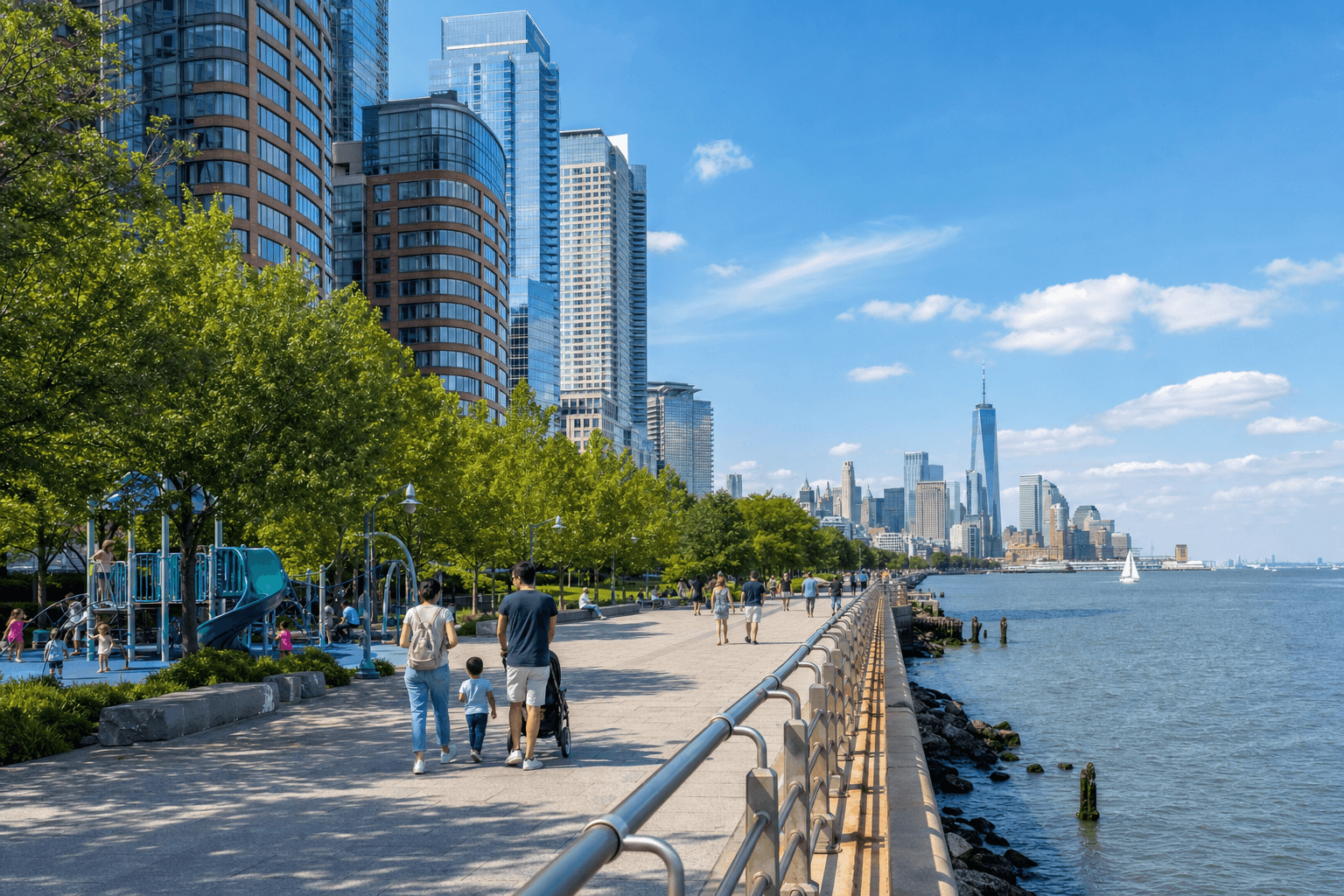
Battery Park City sits at the southern tip of Manhattan, built on landfill created during the original World Trade Center construction in the 1970s. The neighborhood earned its name from the historic Battery Park nearby and has grown into one of the most livable, low-traffic corners of New York City.
Why Families Choose Battery Park City
Families are drawn here for reasons that are easy to identify. The neighborhood has an extensive network of riverfront parks and esplanades, multiple playgrounds, and direct access to the Hudson River waterfront.
Battery Park City leans heavily residential, with a mix of co-ops, condos, and rentals across well-maintained high-rises. Monthly rents for a two-bedroom in the area typically run between $6,000 and $9,500, reflecting both the waterfront premium and the relative quiet compared to Midtown or the Financial District. Battery Park covers a compact, walkable footprint, so most daily errands and school runs are manageable on foot or by stroller.
Park Slope: Brooklyn's Family-Friendly Brownstone Neighborhood
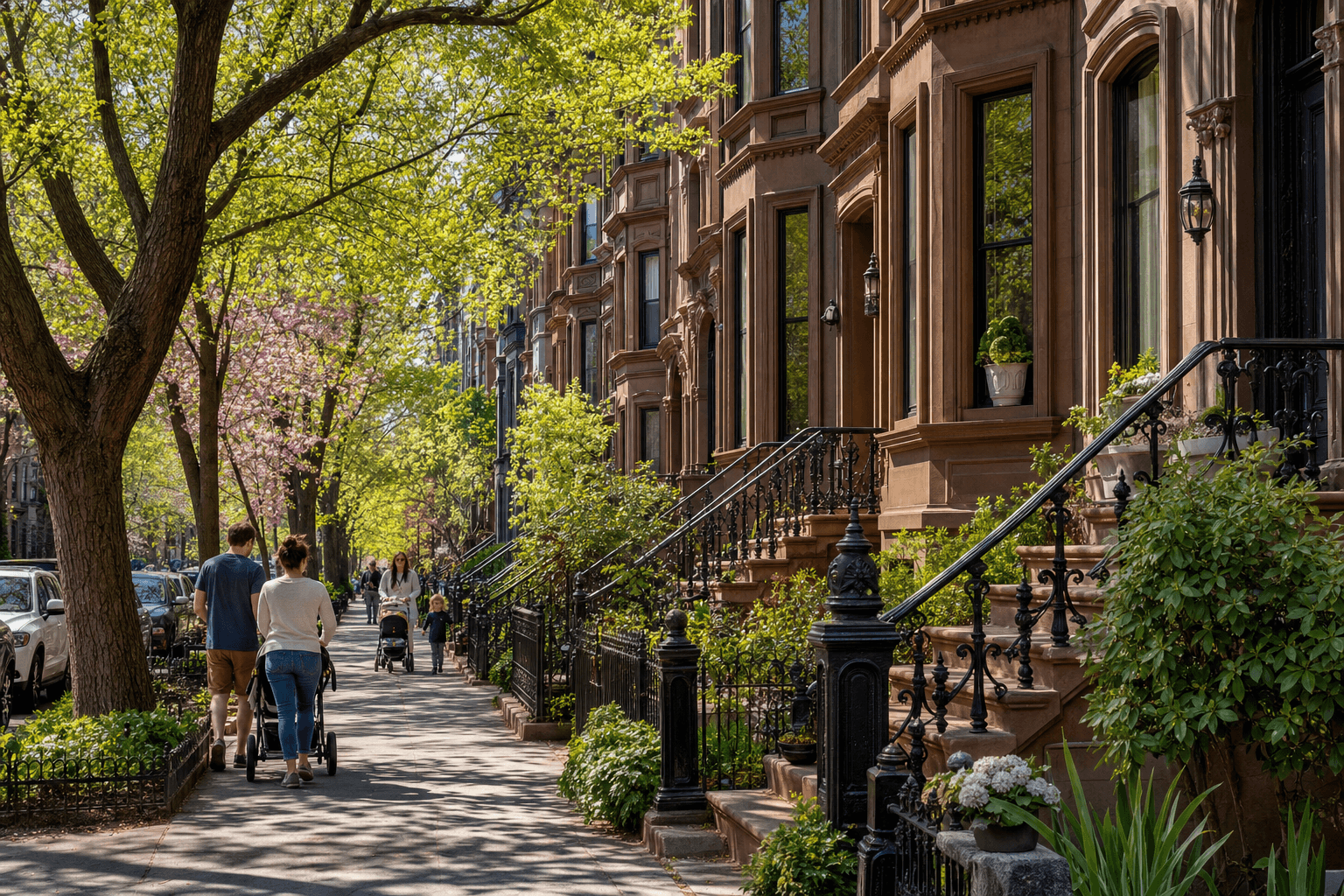
Park Slope sits at the western edge of Prospect Park, and its combination of top-rated schools, tree-lined streets, and well-preserved brownstones has made it one of the most requested Brooklyn neighborhoods for families on extended stays. Monthly rentals here typically run $4,500 to $8,000 for a two- or three-bedroom, depending on proximity to the park and the quality of the building.
Why Families Choose Park Slope
The neighborhood feeds into several of Brooklyn's well-regarded public schools, and PS 321 is widely cited as one of the stronger elementary options in the borough.
| Unit Type | Monthly Rent Range |
|---|---|
| 1-bedroom | $3,200 to $4,800 |
| 2-bedroom | $4,500 to $6,500 |
| 3-bedroom | $6,000 to $8,000 |
Pricing climbs noticeably for renovated units on the park-facing blocks between 1st and 9th Streets. Families planning a stay of 30 days or more will find the most inventory on StreetEasy and through direct outreach to local management companies.
Brooklyn Heights: Historic Charm and Promenade Views
Brooklyn Heights sits directly across the East River from Lower Manhattan, giving families a quieter residential pace while keeping Midtown within a 30-minute commute. The neighborhood is one of NYC's oldest, with 19th-century brownstones lining streets that feel genuinely unhurried compared to the rest of the borough.
The Brooklyn Heights Promenade stretches along the waterfront and offers sweeping views of the Manhattan skyline and East River. For families, it doubles as a daily outdoor corridor connecting the neighborhood to Brooklyn Bridge Park below, where playgrounds, lawns, and a seasonal carousel keep younger kids occupied year-round.
Why Families Choose Brooklyn Heights
- Monthly rental inventory skews toward large brownstone floor-throughs and pre-war apartments, giving families the square footage that Manhattan equivalents rarely offer at the same price point.
- The neighborhood has a walkable main strip along Montague Street with grocery options, pharmacies, and restaurants, reducing car dependency for daily errands.
- Proximity to multiple subway lines makes life manageable without a vehicle.
Brooklyn Heights consistently appears alongside Park Slope and Cobble Hill when families compare the best Brooklyn neighborhoods for families, largely because it combines safety, green space, and transit access in a compact, walkable footprint.
Tribeca: Downtown Luxury and Family-Friendly Amenities
Tribeca runs quieter than its downtown location suggests. Outside the restaurant corridors along Hudson and Greenwich Streets, the neighborhood is mostly residential, giving it a pace that surprises first-time visitors who expect the energy of the Financial District nearby.
Why Families Choose Tribeca
Hudson River Park runs along the western border, with Pier 25 offering a waterfront playground, mini-golf, and athletic fields within walking distance. Loft conversions and historic townhomes here often run 2,000 square feet or more, a floor plan size that most Manhattan neighborhoods rarely match. For families working in Lower Manhattan or the Financial District, Tribeca rentals remove the commute entirely while keeping residential streets and school access intact.
Chelsea and West Village: Walkability and Cultural Access
Chelsea and West Village offer some of the strongest walkability scores in Manhattan, with both neighborhoods consistently ranking in the top tier for car-free daily living. Families who want proximity to cultural institutions will find the Whitney Museum, the High Line, and Hudson River Park within easy reach on foot.
Monthly rental rates in Chelsea and West Village typically run between $8,000 and $18,000 for a two-to-three bedroom unit, depending on floor, views, and building amenities. The trade-off for that access is density: these are among the more crowded neighborhoods in the borough, and outdoor space per unit is limited compared to Brooklyn alternatives like Park Slope or Brooklyn Heights.
Why Families Choose Chelsea and West Village
Families with school-age children will find a mix of public and private options nearby, though competitive admissions and waitlists are common across well-regarded programs in this zone. Grocery access is strong, with multiple full-service options along Seventh and Eighth Avenues.
- The High Line running through Chelsea gives families a car-free outdoor corridor that functions as a daily park substitute, stretching 1.45 miles above street level.
- Hudson River Park's 550 acres of waterfront space along the West Side offer playgrounds, sports fields, and kayak launches within a short walk of most West Village homes.
- Weekend foot traffic in both neighborhoods peaks sharply, which matters for families with young children who need quieter street conditions on a daily basis.
Comparing Manhattan vs. Brooklyn for Family Living
The choice between Manhattan and Brooklyn comes down to how your family weights convenience against space, and price against access. Neither borough is strictly better for families, but the trade-offs are clear enough to make a decision once you know your priorities.
Manhattan wins on proximity. If one or both parents commute to Midtown or Lower Manhattan, living in the same borough removes 30 to 45 minutes from the daily round trip. Cultural institutions, after-school programs, and top-tier private schools are denser here. The downside: you pay a meaningful premium for square footage, and outdoor space per unit is limited.
Brooklyn offers more room for the money. Two- and three-bedroom apartments in Park Slope or Brooklyn Heights typically cost meaningfully less per square foot than Manhattan equivalents, and floor plans in pre-war brownstones run larger than most Manhattan buildings at the same price point. The neighborhood pace is slower, which many families with young children prefer.
| Priority | Manhattan | Brooklyn |
|---|---|---|
| Commute to Midtown | Shorter, more direct | 25 to 40 minutes by subway |
| Square footage per dollar | Lower | Higher |
| Outdoor space per unit | Limited | More common (yards, gardens) |
| School density | Very high | Strong, more concentrated |
| Community feel | Urban, fast-paced | Residential, slower-paced |
Families doing a monthly rental as a test run before committing long-term often find Brooklyn the lower-risk starting point. The cost savings leave room to adjust if the borough does not fit.
What Families Should Know About Monthly Rentals in NYC
Monthly rentals in NYC follow a 30-day minimum stay rule under Local Law 18, effective September 2023. Stays of 30 nights or longer fall outside short-term rental restrictions, opening up full-apartment inventory that shorter bookings cannot access.
- Space requirements add up fast with children. Budget accordingly when searching for two- or three-bedroom units in neighborhoods like Park Slope or Battery Park City.
- Families staying 60 days or more may enroll children in local schools, making proximity to well-rated public schools a practical filter.
- Availability in top family neighborhoods moves quickly, especially for larger units with outdoor space or a doorman.
Finding Your Ideal NYC Neighborhood with Rove Travel
Rove Travel lists over 200 vetted luxury properties across every neighborhood covered in this guide, from Park Slope brownstones to Battery Park City high-rises to Tribeca lofts. Every home arrives fully furnished and move-in ready, with chef-grade kitchens, premium linens, and a 24/7 concierge team available throughout your stay. The 30-plus night model keeps your booking fully compliant with Local Law 18 and opens up the full-apartment inventory that shorter stays cannot access.
Browse by neighborhood on Rove Travel to find the right fit for your family.
Final Thoughts on NYC Neighborhood Selection for Families
Most families overweight aesthetics early, then realize school access and commute time drive satisfaction more than architecture. If you're relocating or considering a move, a 30-plus night rental removes the guesswork by letting you live the daily routine before committing. Rove Travel offers vetted homes across Park Slope, Battery Park City, Brooklyn Heights, and every other family-focused neighborhood here. Rank your priorities, test your top two choices, then decide with real data instead of assumptions.
FAQ
Park Slope vs Brooklyn Heights for families with young children?
Park Slope borders Prospect Park's 585 acres and feeds into PS 321, one of Brooklyn's top-rated elementary schools, making it ideal for families focused on outdoor access and school quality.
Can I enroll my child in a NYC public school zone with a monthly rental?
Yes. Families securing monthly rentals of 30 nights or more often qualify to enroll in the local zone school, making neighborhood selection a direct education decision. Check the specific school's requirements, but extended stays typically build the residency needed for public school access.
What's the real cost difference between Battery Park City and Park Slope for a two-bedroom?
Battery Park City two-bedrooms typically run $6,000 to $9,500 monthly, reflecting the waterfront premium and building amenities. Park Slope two-bedrooms range from $4,500 to $6,500, offering 20 to 35 percent lower costs per square foot while maintaining strong school access and park proximity.
Best neighborhoods in Brooklyn for families who need a Manhattan commute under 30 minutes?
Brooklyn Heights delivers the shortest commute with multiple subway lines (2, 3, 4, 5, A, C, F) reaching Lower Manhattan in under 20 minutes and Midtown in roughly 30 minutes. Park Slope follows with the F, G, R, and Q lines getting you to Manhattan in 25 to 35 minutes, depending on your destination.
How do I find monthly rentals in NYC that comply with the 30-day rule?
Stays of 30 nights or longer fall outside Local Law 18's short-term rental restrictions, opening up full-apartment inventory that shorter bookings cannot access. Rove Travel lists over 200 vetted properties across Park Slope, Battery Park City, Brooklyn Heights, and other family neighborhoods, all fully furnished and compliant with the 30-plus night requirement.