A Furnished NYC Rental Can Bridge the Gap When You're Between Homes | September 2026
The scenario happens more often than you'd think: a job offer lands faster than expected, a lease renewal falls through, a renovation runs long, or you're relocating from another city and can't sign a permanent lease before you've seen the neighborhoods yourself. Each situation is different, but they all arrive at the same place: you need a place to to call home during that in-between period before you settle down permanently.
You've got a start date, a neighborhood in mind, and zero signed leases. That in-between stretch is one of the trickiest parts of any NYC relocation, and most people don't figure out their options until they're already scrambling. This is what actually works.
TLDR:
- NYC's 30-night rule (Local Law 18) makes sub-30-day furnished apartment rentals illegal, so your search starts at 30 days minimum
- The relocation gap between homes runs 6 to 12 weeks for most people, too long for a hotel and too short for a standard 12-month lease
- A furnished apartment costs $5,200 to $14,000/month vs. $7,500 to $18,000+ for an extended-stay hotel suite with far less space
- Confirm kitchen equipment, in-unit laundry, a dedicated desk, and high-speed internet in writing before you book anything
- Rove Travel offers curated furnished rentals across Manhattan and Brooklyn with a 30-night minimum, instant booking, and no broker fees
The In-Between Problem: Why Your NYC Housing Timeline Never Lines Up
What makes NYC uniquely unforgiving is the pace. Apartments move in hours. Without a local mailing location or a signed offer letter that satisfies income requirements, even touring feels rushed. The standard lease is 12 months, which is the last commitment you want when you're still deciding which neighborhood fits your life. Renting in NYC comes with its own set of rules that are worth understanding before you start.
The gap is rarely as short as people expect. Between application timelines, moving logistics, and real estate delays, six to twelve weeks is common. That window is too long for a hotel, too short for a traditional lease, and too consequential to spend somewhere that doesn't work.
NYC's 30-Night Rental Rule and Why It Shapes Your Options
Local Law 18, signed in January 2022 and enforced since September 2023, reshaped what temporary housing in New York City actually looks like. The law requires anyone renting a dwelling for fewer than 30 days to register with the Mayor's Office of Special Enforcement, be physically present during the guest's stay, and cap occupancy at two guests. Renting an entire apartment for under 30 days in a standard residential building is effectively prohibited.
For someone relocating, this has a direct practical consequence. Booking a furnished apartment for two or three weeks through a vacation rental app is no longer a realistic option in most NYC buildings. The supply of legally compliant sub-30-day entire-apartment rentals dropped sharply after enforcement began in September 2023.
Rentals of 30 consecutive days or more are exempt from Local Law 18's restrictions. You can book an entire furnished apartment without a host present, without a two-guest cap, and without registration complexity. That is the framework your search needs to operate within.
What "Furnished" Actually Means in NYC
"Furnished" in New York City covers a wide range. On one end: a bed frame, a couch, and maybe a table. On the other: a fully equipped apartment you can move into on day one without buying a thing. Both get listed as furnished.
For a weekend trip, the difference barely matters. For six weeks during a relocation, it matters considerably. Cooking meals, working from the apartment, and running a real daily routine out of a bare-bones setup means immediate trips to buy linens, cookware, cleaning supplies, and a desk lamp.
Before booking, confirm each of the following:
- Kitchen equipment: full-size fridge, gas or induction range, dishwasher, quality cookware, knives, and tableware for at least two
- Linens and towels: included and clean at check-in
- Workspace: a dedicated desk with monitor and keyboard, beyond a bare table
- Laundry: in-unit washer and dryer, or building laundry at minimum
- Internet: high-speed, already set up on arrival
- Toiletries and basics: enough to get through the first night
Photos tell you almost nothing about whether a kitchen is actually stocked. Ask the host or manager directly, in writing, before you commit. For a deeper walkthrough, see the guide on short term furnished rentals in NYC.
The True Upfront Cost of a Traditional Short-Term Rental Search
Finding a furnished short-term rental through traditional channels in NYC means absorbing several costs before you spend a single night.
The standard upfront stack: first month's rent, last month's rent, and a security deposit capped at one month's rent under New York State law. On a $5,000/month furnished apartment, that's $15,000 due at signing. The FARE Act, effective June 2025, shifted broker fee responsibility to the hiring party in standard long-term leases, but the furnished and short-term rental market operates differently. Individual owners and small operators often structure deals that still include fees, and renters who hire their own broker remain responsible for that cost. According to data cited by Byson, the average total cost to secure a lease in NYC reached $12,951 in 2024, a 24% jump from the prior year.
For relocators on a deadline, the timeline compounds the cost. Searching, touring, applying, and signing can take weeks. Listings disappear before applications clear. And once you're in, there's no concierge, no maintenance support, no one to call when the heat goes out on a Sunday.
Where to Find a Short-Term Furnished Rental in NYC
Four main channels exist for finding a furnished rental in NYC during a relocation, each with a different set of trade-offs.
Specialized furnished rental platforms are purpose-built for 30+ night stays, listing pre-vetted monthly furnished apartments in NYC with transparent pricing and often instant booking. Quality consistency is higher because properties are screened before listing. Rove Travel operates in this category, with over 200 properties across Manhattan and Brooklyn. Blueground is another option, with a larger but more standardized inventory skewed toward functional mid-range units.
StreetEasy and Zillow both have furnished filters, but quality varies sharply from listing to listing. Expect the full upfront cost stack and a multi-week process from search to signed lease.
Corporate housing NYC companies are designed for extended work assignments, offering furnished units with predictable lease terms and professional management. Pricing tends to run higher than comparable apartments booked directly, and inventory is narrower.
Sublet networks like Facebook groups, Craigslist, and niche sublet boards surface real options, often at lower prices. Vetting falls entirely on you. Scams are common, lease terms are informal, and there is no damage protection or support if something goes wrong.
The right channel depends on how much time you have and how much risk you can absorb.
What to Expect from Lease Terms and Requirements
Most furnished rental companies run their own vetting: ID verification, fraud screening, and income checks. Security deposit structures vary too: some collect a cash deposit, others hold a credit card authorization. Ask before you book what the hold amount is and when it releases after checkout.
Traditional NYC landlords typically require income at 40 times the monthly rent, meaning a $5,000/month apartment requires $200,000 in annual income documentation. Expect pay stubs, tax returns, bank statements, and a credit check. International renters without U.S. credit history often need to offer additional months upfront or a guarantor.
Minimum stay requirements shape your options as well. Under NYC's 30-night rule, mid-term rentals for relocating professionals run 30 days minimum. Many providers set their own floor higher, at 60 or 90 days, depending on the property and season. Build that into your search if your gap is shorter.
Short-Term Rental vs. Extended-Stay Hotel: A Cost Comparison
For a 30 to 90 night relocation stay, the cost difference between a furnished apartment and an extended-stay hotel compounds fast. Furnished apartments in NYC run $5,200 to $14,000 per month depending on size and neighborhood. Extended-stay hotels in Manhattan routinely exceed $250 to $400 per night for a suite with a kitchenette. For a full breakdown of NYC hotel vs. furnished rental costs, the numbers compound quickly over a 30-night stay.
Price is one part. Livability is the other. A hotel room works for a week. At week four, the absence of a real kitchen, a dedicated workspace, in-unit laundry, and separation between sleeping and working starts to wear.
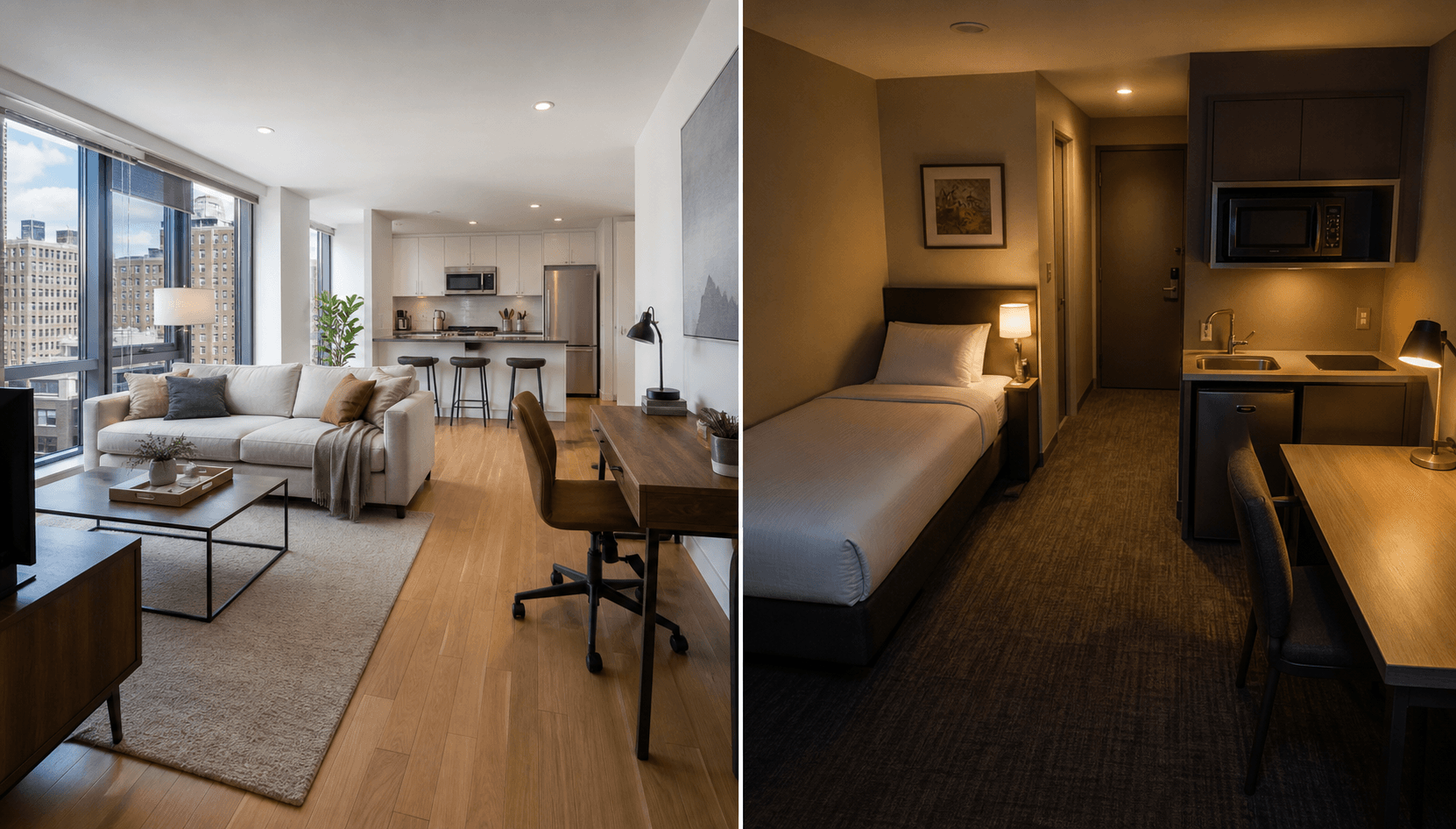
| Furnished Apartment | Extended-Stay Hotel | |
|---|---|---|
| Monthly cost (est.) | $5,200 - $14,000 | $7,500 - $18,000+ |
| Full kitchen | Yes | Kitchenette only |
| In-unit laundry | Most units | Rarely |
| Dedicated workspace | Yes | Desk, no monitor |
| Square footage | 600 - 2,000+ sq ft | 350 - 600 sq ft |
| Neighborhood feel | Residential | Tourist/commercial |
The hotel wins only on flexibility for stays under two weeks, where the upfront cost and application process of a furnished rental is harder to support financially. Beyond that threshold, the apartment wins on function and cost.
Best NYC Neighborhoods for Short-Term Rentals During a Relocation
Each neighborhood here offers a different version of the same calculation: where does daily life work best for the next 30 to 60 days, not the next decade.
Manhattan
Midtown suits relocators whose office is nearby and who want to keep commute friction low while everything else is unsettled. It has the highest concentration of doorman buildings with furnished inventory and strong transit access across the borough. The trade-off is residential feel: Midtown is dense and commercial, not a neighborhood you settle into.
The Upper West Side and Upper East Side work well for families or anyone who needs quieter streets, park access, and proximity to schools. Both have solid grocery infrastructure and a residential rhythm that makes a six-week stay feel grounded.
Tribeca and the West Village offer the most livable version of Manhattan for someone who wants comfort and neighborhood character during a stressful transition. Inventory skews higher-end, but walkability and dining within a few blocks makes daily life manageable.
Brooklyn
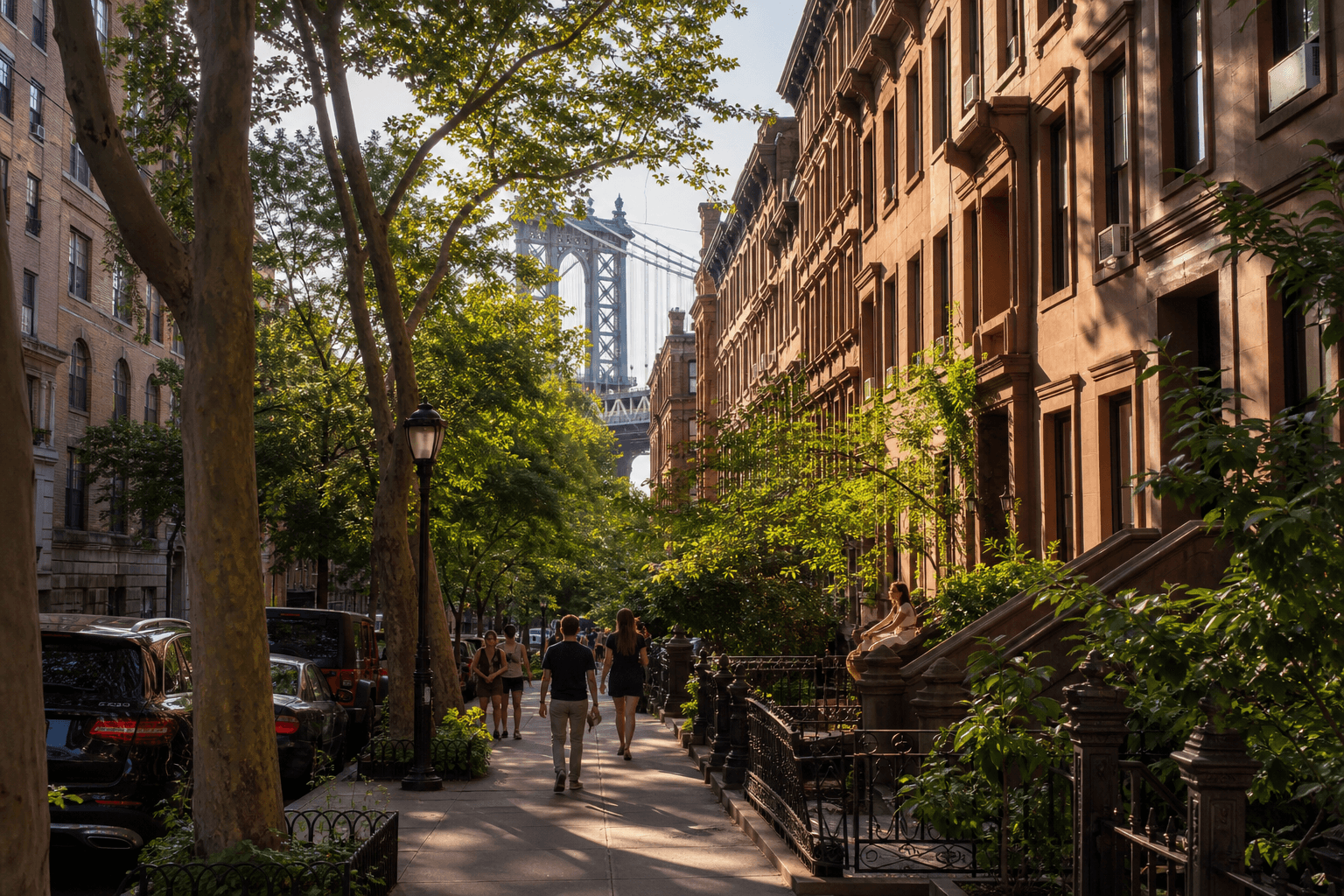
Brooklyn Heights delivers Manhattan views and a 10-minute subway ride with noticeably more space per dollar. Prospect Heights sits near Prospect Park, with a quieter residential feel than most of Manhattan at comparable price points. Williamsburg is best if you want energy: waterfront access, a strong restaurant scene, and reliable L train frequency into Manhattan.
Start with your office or most frequent commitment and map backward. The best temporary neighborhood removes friction from the next 60 days.
Red Flags and Scams to Watch For
Scams in the NYC furnished rental market are common enough to warrant a checklist before you wire anything.
The most frequent problem is the phantom listing: a unit rented weeks ago, still posted on Craigslist or a sublet forum to harvest leads. A close second is the photo mismatch, where professional images are lifted from a previous renovation or a different property entirely. Book a video call and ask the host to walk the apartment live before committing.
Watch for these in particular:
- Wire transfer requests before a lease is signed
- Owners who cannot produce proof of ownership or a management agreement
- Subletters with no written authorization from the building owner
- Listings with no verifiable location: ask for the full unit location before paying anything
- Prices far below market rate for the neighborhood and unit size
- Landlords who claim a 30-day stay is fine in a building with no verifiable permit history
The legality question matters too. Under Local Law 18, renting an entire apartment for fewer than 30 days without a registered host present is prohibited in most NYC residential buildings. If someone offers you a two-week furnished rental in a standard apartment building, ask directly how it complies. Vague answers are a signal.
Pay by credit card where possible. It gives you a dispute path that a wire transfer does not.
How Rove Travel Approaches the NYC Relocation Gap
We built Rove for exactly the gap this article describes. Our NYC portfolio covers over 200 properties across Manhattan and Brooklyn, every one vetted against a consistent design and quality standard before it's ever listed. A 4.8-star average guest rating and 85%+ portfolio occupancy rate (Rove Travel internal data) reflect what happens when inventory is curated instead of open to anyone who wants to post.
Every stay requires a 30-night minimum, which aligns with Local Law 18 and means you get a fully private, host-free apartment with no registration uncertainty. Booking happens online in minutes, no broker involved. The guest service fee on direct bookings at RoveTravel.com runs 10 to 12%, with direct pricing typically running below Airbnb on the same property and an additional 3 to 10% savings for booking directly.
Our concierge team is available around the clock from pre-arrival through checkout, handling maintenance issues, cleaning coordination, and anything else that comes up mid-stay. For someone working through a relocation, that coverage removes a category of friction that a self-managed sublet or broker-mediated furnished rental cannot match.
Browse available NYC properties at RoveTravel.com.
Final Thoughts on Using Short-Term Rentals to Bridge Your NYC Housing Gap
Understanding Local Law 18, what upfront costs to expect, and which red flags to watch for gives you a real advantage in a market that moves quickly. Treat your short-term rental as a tool for making a smarter permanent decision, a functional base for learning the city instead of a holding pattern. For a curated list of move-in-ready furnished apartments across Manhattan and Brooklyn, Rove Travel is a solid place to start your search.
FAQ
What's a good alternative to Airbnb for booking a luxury furnished apartment in NYC for a month?
Specialized furnished rental platforms built for 30+ night stays are the most direct alternative. Rove Travel lists over 200 vetted properties across Manhattan and Brooklyn with instant online booking, no broker involved, and direct pricing that typically runs below Airbnb on the same property, plus an additional 3 to 10% savings for booking directly at RoveTravel.com. Blueground is another option with broader inventory, though its units skew toward functional mid-range instead of curated luxury.
How do I find a short-term furnished rental in NYC that's actually legal under Local Law 18?
Book any furnished rental as a 30-consecutive-night minimum stay or longer. Rentals of 30 days or more are exempt from Local Law 18's restrictions, meaning you get a fully private, host-free apartment without registration complexity or a two-guest cap. Platforms purpose-built for 30+ night stays, like Rove Travel, are structured around this requirement by design. If someone offers you a two-week furnished rental in a standard NYC apartment building, ask how it complies before paying anything.
Short-term NYC furnished rental vs. extended-stay hotel for a 30 to 60 night relocation: which actually costs less?
A furnished apartment runs roughly $5,200 to $14,000 per month depending on size and neighborhood; extended-stay hotels in Manhattan regularly run $7,500 to $18,000 or more for a fraction of the space. Beyond the cost gap, the livability difference compounds fast. A hotel room works for a week, but by week four the absence of a real kitchen, in-unit laundry, and a dedicated workspace becomes a real friction point for anyone working a full daily routine out of the space.
Should I use a sublet network or a furnished rental platform for a NYC relocation between homes?
Sublet networks like Craigslist and Facebook groups can surface lower prices, but vetting falls entirely on you: scams are common, lease terms are informal, and there is no damage protection or support if something goes wrong mid-stay. A furnished rental platform with pre-screened inventory, ID verification, a signed rental agreement, and 24/7 concierge support removes a category of risk that matters most when you are in the middle of a relocation and cannot afford to lose time or housing. If your gap is 30 days or longer and you need a functional home base, the platform route is the more reliable path.
Can I book a short-term rental nyc relocation between homes if I don't yet have a local NYC residence or signed permanent lease?
Yes, furnished rental platforms that serve relocators do not require a local residence on file or an existing NYC lease to book. Standard vetting typically includes ID verification, fraud screening, and income checks, which you can complete before arriving in the city. Having a short-term rental location on record before you start your permanent apartment search also helps: some NYC landlords and co-op boards look more favorably on applicants already living in the city when reviewing applications.